Andean and Southamerican music in Yugoslavia
THIS PAGE UPDATED CONSTANTLY
Latin american music in general was introduced mostly in the '60
and '70 by the famous
ensemble Magnifico (Tavsanov
Krsto, Kocovski Petar, Galev Petar ...) from Macedonia. It is
alleged that they sang in such authentic manner that even born Latin-Americans
could not
recognize where the members come from.
With the exception of one concert of legendary peruvian vocal artist Yma Sumac (clickhereforOfficial Authorized Yma Sumac Home page)in Belgrade somewhere in the '60 (which as it is still remembered was a great and unforgetfull musical event), it was not until the late '70 that this expansion of popularity began. In 1978 and 1979 Facio Santillan and his orchestra had two recitals in Belgrade and several more in other towns, while group Kusikuna (Carlos Ben Pott and his friends Leo La Rocca, Daniel La Faye and J. Paul Pacé) came in 1982 and had a lot of success.
During the '80 there were several artists or groups worth mentioning. Trio Amerindia, the mixed latin american group settled in Belgrade (two members from Bolivia - one of them being Reinaldo Velarde, and Juan David Galdámez from Colombia) had recitals in the principal concert halls and managed to make one LP recording of andean and popular colombian music. We have also to mention excellent performings of peruvian guitarist Pepe Torres, who came several times and gave recitals alone or with Ballet folklóriko del Perú.
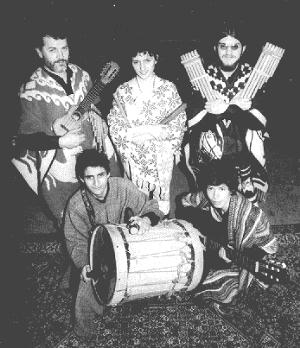
The '80 were also in the sign of an excellent group called Ayllu settled in Zagreb. There were several bolivians (whose ancestors originated from Croatia) who managed to get yugoslav grants for their studies at Zagreb University. Soon after their arrival they arised interest in andean music, so that their yugoslav friends and musicians started to learn to play it. As far as we know they had a lot of very good concerts all over the ex-Yugoslavia. Their work is saved on three LP recordings. The following members are signed as performers:
Enrique Alejandro González (siku, guitar,
bombo)
Jorge Fernando Quiiriguin (charango,
siku, bombo)
Darko Horvat (guitar, charango, quena,
tarka, quenacho)
Milton Arandia Antezana (vocal, guitar,
charango, bombo)
Juan Luis González (bombo, siku, ch'ajchas)
Robert Lovrić (quena, siku, quenacho,
tarka, pusipias)
Zrinka Božićević (quena, siku, vocal)
Branimir Ranogajec (violin, ch'ajchas)
Rade Pažameta (guitar, siku)
The same situation occured in Bosnia. Two bolivians got yugoslav grants for their studies in Sarajevo and managed to create a group called Inti. They didn't make any recordings, but had very good concerts in Sarajevo, Slovenia and Italy. Their members:
Tihomir Ekmečić (charango)
Esmeralda Kadrić (quena)
Eduardo Revollo Revira
(guitar)
Carlos ? (bombo)
Boris ? (siku)
Milorad Romić (guitar, siku)
According to information of our bolivian friends from P'unchay, in the early '90 there was a group called K'ara LLanta